What Does Hearing Loss Sound Like?
You may wonder what hearing loss actually sounds like, but the truth is that there’s no single answer. Hearing loss doesn’t sound the same for everyone, and that’s part of why it’s so difficult to recognize.
You might expect hearing loss to be obvious, as if you flipped a switch and suddenly everything is silent. In reality, it’s often experienced as a gradual, subtle change. It can also be situational, affecting you more in certain environments than others.
Many people struggle to describe what they’re experiencing when their hearing changes. It’s not just about “not hearing” but about missing pieces, clarity, or certain tones.
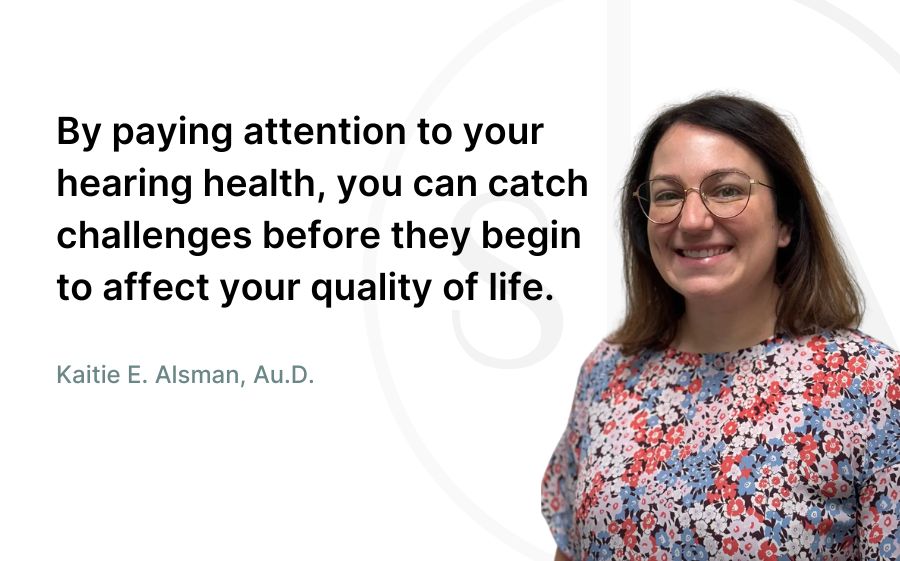
Because these changes are slow and often inconsistent, hearing loss is frequently overlooked, even by people who are otherwise attentive to their health. However, by paying attention to your hearing health, you can catch challenges before they begin to affect your quality of life.
Common Ways People Describe Hearing Loss
For many, speech starts to sound muffled or unclear, as if people are mumbling. You may notice that softer consonant sounds, like “s,” “f,” “th,” and “sh,” are especially hard to pick out. This can make it seem like you’re hearing something but not understanding the words.
You might find yourself turning the TV up louder than others prefer, or asking people to repeat themselves more often. Perhaps you hear just fine in quiet settings, but struggle to follow conversations in groups, restaurants, or other noisy places.
These are all real experiences that people like you face every day, and they can be frustrating, isolating, and concerning. But you don’t have to face them alone.
How Different Types of Hearing Loss Can Sound
High-Frequency Hearing Loss
High-frequency hearing loss is by far the most common; with this kind of hearing loss, you may notice that voices, especially those of women and children, are harder to understand.
The clarity of speech fades, and sounds like birds chirping or electronic beeps might disappear first. Everyday communication becomes challenging not because you can’t hear at all, but because you’re missing the crispness and detail that make words clear.
Are your kids’ or grandkids’ voices sounding far away, or does it feel like everyone is mumbling? Have you more than once missed the doorbell or a phone call? These aren’t one-off happenstances, but signals that your hearing might be struggling.
Low-Frequency Hearing Loss
While it’s much less common, some people experience low-frequency hearing loss. If this affects you, deeper voices may be harder to follow, and speech can sound flat or distant. You may feel as though you’re listening through a wall or underwater.
While this type of hearing challenge is rare compared to high-frequency hearing loss, you deserve the same level of care and attentiveness to help your hearing health improve.
Uneven or One-Sided Hearing Loss
You may also experience uneven or one-sided hearing loss, where one ear struggles to hear more than the other.
This can make it difficult to localize where sounds are coming from, making conversations feel disorienting. You might turn your head to “catch” the sound or feel off-balance in group discussions. These subtle shifts can have a big impact on your daily life.
Why Hearing Loss Is Often Missed (Even by Smart, Attentive People)
You’re not alone if you’ve missed the signs of hearing loss challenges.
The brain is remarkably good at filling in missing information, so you may unconsciously compensate for what you’re not hearing. And it’s easy to blame your difficulties on background noise, accents, or others “not speaking clearly.”
Hearing loss is usually gradual, so you adapt without realizing it, making day-to-day shifts almost invisible. Often, your loved ones notice changes before you do; they might comment on the volume of the TV or how often you ask them to repeat themselves.
This is why you benefit from a thorough, professional hearing assessment, where you can expect comprehensive testing and education, not assumptions. You deserve answers based on real data and a process that puts your unique needs first. Your hearing optimization journey should be tailor-made for you, not a one-size-fits-all approach.
How SLA Audiology Helps You Understand What You’re Hearing
You can rest assured that a hearing assessment run by our team of experts goes beyond the basics.
Instead of just seeing whether you can hear a beep, you receive comprehensive assessments that include speech-in-noise testing. This reflects real-world listening situations, so you get a clearer picture of your actual hearing abilities.
You then benefit from clear explanations of your results, not just charts or numbers: Our team takes the time to walk you through what your hearing assessment results mean, using language you can understand.
If your hearing is normal, you’ll have established a baseline for future reference. If there are challenges, you’ll discuss all your options with professionals who care about your unique needs and requirements, not about making a sale.
Hearing care at SLA Audiology is about your needs and your choices, not about pushing devices. You receive honest guidance and support every step of the way.
Get Clear Answers, Not Guesswork
If any of these symptoms sound familiar, you owe it to yourself to get clarity.
Scheduling a comprehensive hearing assessment will help you understand your hearing early and give you control and choice over your health. It’s not about just checking a box; it’s about truly understanding what you’re hearing and how you can enhance your hearing health.
To get started on your hearing health journey, don’t hesitate to get in touch with our team. You can rest assured that there’s no pressure and no assumptions at SLA Audiology, just clarity, support, and answers you can trust.
Frequently Asked Questions (FAQ)
Q: How can I tell if my hearing loss is high-frequency or low-frequency?
A: A professional hearing assessment is the best way to measure your ability to hear different pitches and frequencies.
High-frequency hearing loss is most common and often affects the ability to hear higher-pitched sounds, like women’s voices or birdsong. Low-frequency hearing loss is rare and usually makes deeper voices or background sounds harder to detect.
A comprehensive hearing assessment from our team can give you a clear answer and options for optimizing your hearing health.
Q: Why do I hear people talking but struggle to understand what they’re saying?
A: You may be experiencing hearing loss that affects clarity rather than volume. This is especially true with high-frequency hearing loss, where you can hear sounds but miss important speech details.
Q: Will I be pressured to get hearing aids if I schedule a hearing test?
A: At SLA Audiology, the focus is on your needs and your hearing health, not on selling devices. If your hearing is normal, you’ll simply establish a baseline to make it easier to catch changes in the future. If the assessment finds you are experiencing hearing challenges, you’ll discuss all available options with our team, with no pressure to choose hearing aids unless they’re truly the right fit for you.
Source
Healthline: Learn more about high-frequency hearing challenges, including symptoms, causes, and options for treatment!

Kaitie E. Alsman, Au.D.
Search
Request a Callback
Get expert hearing care at SLA Audiology. Whether you need a hearing test, tinnitus treatment, or custom hearing solutions, our specialists are here to help.